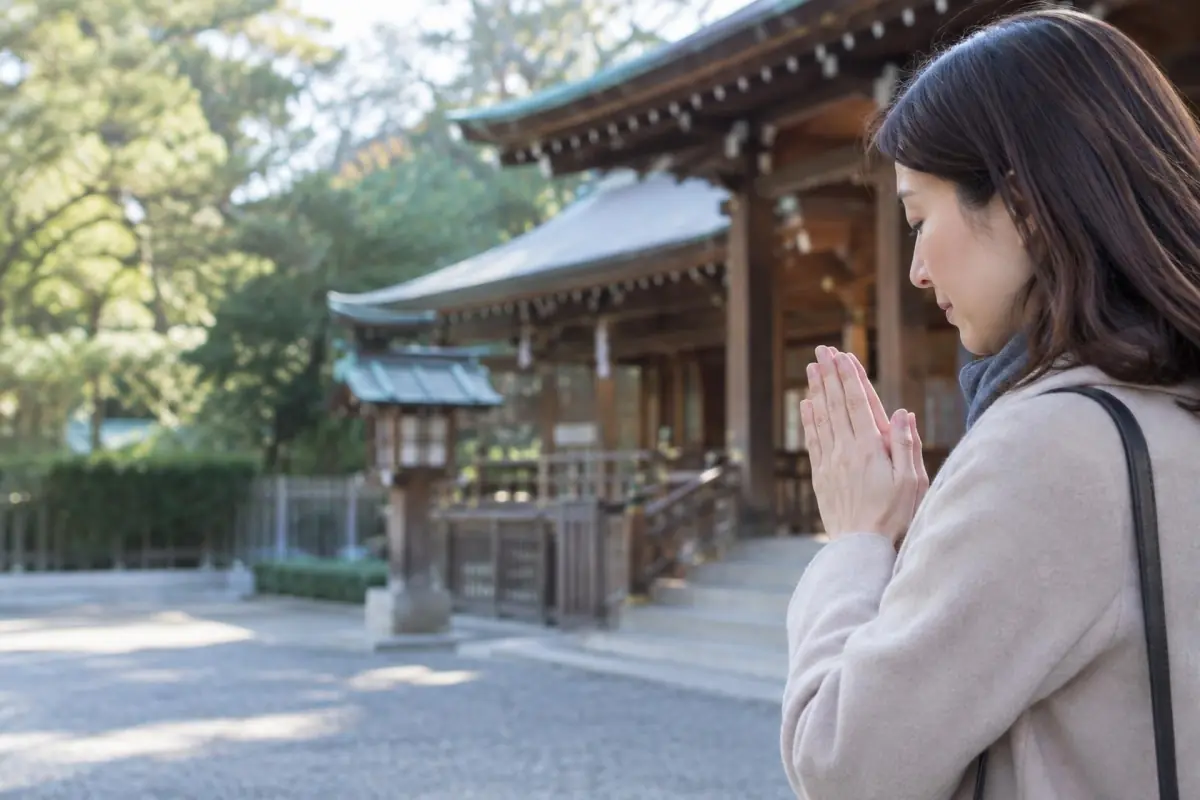
Who is Okuninushi?
Okuninushi no Ōkami (大国主大神) is the deity enshrined at Izumo Taisha. Many people also call him Daikoku-sama. He is worshipped above all for enmusubi, which is often translated as matchmaking. The shrine itself gives the word a wider meaning: the ties between people, and beyond that the connections that make up a shared life. Enmusubi is not limited to finding a partner or to marriage.
That wider meaning matters when you visit. Whatever tie you pray for, a prayer here is an act of faith and a custom, not a promise of a result.
If you want the stories told on the spot, a guided walk through Izumo Taisha takes 1.5 to 2 hours and passes the places described on this page.

The myth of the handed-over land
How the shrine explains its own origin.
The shrine traces its origin to the myth of Kuniyuzuri, the handing over of the land. In this story Okuninushi gives up rule over the land to the descendants of the sun goddess Amaterasu. In return he receives a great shrine. Izumo Taisha sees itself as that shrine.
This is a religious story, not a dated founding. Izumo Taisha appears in early written works such as the Kojiki and the Nihon shoki, but no exact founding year has come down to us. The shrine's earlier name was Kizuki no Ōyashiro; it has been called Izumo Ōyashiro since 1871. The history page follows the shrine from the myth to the Main Hall of 1744.
Our picks: private tours around Izumo Taisha
Hand-picked tours, booked through GetYourGuide. Prices are indicative starting prices in US dollars (as of October 2026). Tap a tour for live availability and the current price in your currency.

From Osaka: four-day private tour to the Tottori dunes and Izumo Taisha
- Private van for your group only
- English-speaking driver-guide
- Entry to the Sand Museum, Adachi Museum and Matsue Castle
- Horikawa moat boat ride
Four days by van through Tottori and Shimane, with Izumo Taisha as one stop. Hotels are not part of the price.
Check availability →
Yuushien and Adachi Museum of Art by private car
- Adachi Museum and Yuushien admission
- Private car and licensed guide
- Flower Park admission
Eight hours that tie the gardens and the museum into one day. The main admissions are covered; lunch is on you.
Check availability →Izumo Taisha with a guide
Guided walks through the shrine grounds and day trips that combine Izumo Taisha with Matsue and Lake Shinji.
The White Hare of Inaba
The best-known story about Okuninushi is that of the White Hare of Inaba. A hare has been hurt, and Okuninushi's brothers give it advice that makes its pain worse. Okuninushi tells it to wash in fresh water and to lie on cattail flowers, and the hare recovers.
On the grounds a bronze group shows this scene. You will also find smaller hare figures behind the Main Hall, in the garden and near the Kaguraden. Looking for them is a quiet way to walk the grounds.

Enmusubi at Izumo Taisha
Where the idea of ties shows up during a visit.
Prayer
You pray to Okuninushi with two bows, four claps and one bow, at the Haiden, at the Yatsuashi Gate and at the other shrine buildings. The route is on the visiting page.
Ema
Visitors write wishes on wooden ema plaques. The enmusubi ema costs ¥500 in the small and ¥1,000 in the large size (2026).
Omamori
The enmusubi charms come in purple, red and green, at ¥1,000 each (2026). Other charms cover warding off misfortune, long life, studies, safe childbirth, health and traffic safety. See omamori.
Enmusubi Taisai
During Kamiarizuki the shrine holds the Enmusubi Taisai, in 2026 on 23 and 25 November. Places are reserved in advance. Dates and crowds are on the best time to visit page.
Daikoku-sama, Ebisu and the visit to Miho
As Daikoku-sama, Okuninushi is linked with Kotoshironushi, also known as Ebisu, who is worshipped at the Miho Shrine. In local tradition the two are father and son. From that comes the custom of ryōmairi: visiting both Izumo Taisha and the Miho Shrine.
Ryōmairi is a custom, not a duty, and there is no required order. Miho is a separate trip from Izumo, not a walk from the shrine. The shrines near Izumo Taisha page covers Miho together with Yaegaki, Susa and Hinomisaki.

Other deities around Izumo
Okuninushi is not the only deity linked with the region.
| Shrine | Deities | Note |
|---|---|---|
| Izumo Taisha | Okuninushi no Okami | Two bows, four claps, one bow |
| Miho Shrine | Kotoshironushi (Ebisu) | Ryōmairi custom with Izumo Taisha |
| Yaegaki Shrine, Matsue | Susanoo and Inatahime | Kagami no Ike pond for a fortune custom |
| Susa Shrine | Susanoo, with Inatahime, Ashinazuchi and Tenazuchi | Bus line towards Susa-jinja-mae |
| Hinomisaki Shrine | Amaterasu (Hishizumi-no-Miya) and Susanoo (Kami-no-Miya) | Two bows, two claps, one bow |
For most visitors with one day, Izumo Taisha plus Inasa Beach on foot is the natural pair. With a second day, add Yaegaki in Matsue or the Hinomisaki Shrine on the cape.
Kamiarizuki: the month of the gods
Why November 2026 is a special time at Izumo Taisha.
Kamiarizuki is the tenth month of the old lunar calendar. In Izumo it is the month in which the gods are welcomed. In 2026 the welcoming ceremony Kamimukae takes place at Inasa Beach on 18 November at 19:00; afterwards the procession moves to the shrine. The main days of the Kamiarisai are 19, 23 and 25 November, and the farewell is on 25 November at 16:00. Traffic rules apply around the shrine from 19 to 23 November.
Okuninushi and Izumo Taisha: FAQ
Is Izumo Taisha only a shrine for finding a partner?
No. Enmusubi means ties between people in a broad sense, and beyond that the connections of shared life. Finding a partner and marriage are part of it, but the idea is not limited to them.
Who is Daikoku-sama?
Daikoku-sama is another name under which Okuninushi no Okami is worshipped. Through the custom of ryōmairi he is linked with Kotoshironushi, or Ebisu, at the Miho Shrine.
Why are there hare statues at Izumo Taisha?
They recall the myth of the White Hare of Inaba, which Okuninushi helped. A bronze group shows the scene, and smaller figures stand behind the Main Hall, in the garden and near the Kaguraden.
When was Izumo Taisha founded?
No exact founding date has come down to us. The shrine explains its origin through the Kuniyuzuri myth, and it appears in the Kojiki and the Nihon shoki. The present Main Hall dates from 1744.
Do I have to visit the Miho Shrine as well?
No. Visiting both shrines is a custom some people follow, not a rule, and there is no fixed order.