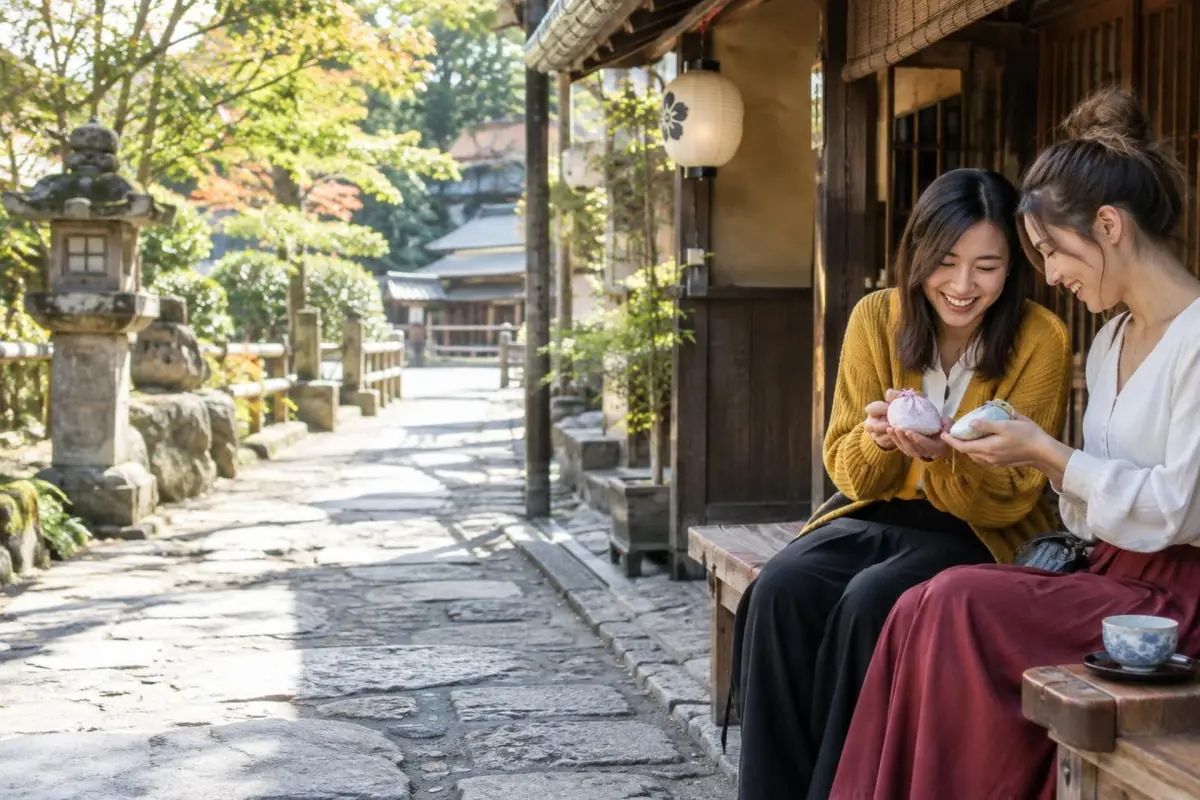
Izumo Taisha omamori at a glance
Omamori are small protective charms that a shrine hands out in return for an offering. At Izumo Taisha, the shrine of the deity Okuninushi, the charms most visitors look for are the enmusubi charms. Enmusubi means the ties between people, and the shrine explains it as more than finding a partner: it covers relationships in general and the bonds that shape a shared life. You will also find charms for warding off misfortune, for health, for study, for a safe birth and a traffic safety tablet for your car.
Izumo Taisha omamori are received at the shrine counter on the grounds. The regular counter is open from 8:30 to 16:30, and in the early morning and evening a provisional counter takes over. A second, separate place to receive charms is the Kitajima Kokusokan, which belongs to its own religious body and has its own range.

Which charm is for what
The shrine offers a range of charms in 2026. Not every item is a charm in the narrow sense: some are tablets, plaques or objects for daily use. Here are the ones you are most likely to look for, with the offering for 2026.
| Item | What it stands for | Offering (2026) |
|---|---|---|
| Enmusubi charm | Ties between people, in purple, red or green | ¥1,000 |
| Yakuyoke charm | Warding off misfortune | ¥1,000 |
| Longevity charm | A long life | ¥1,000 |
| Study charm | Learning and exams | ¥1,000 |
| Safe birth charm | Pregnancy and birth | ¥1,000 |
| Health charm | Physical well-being | ¥1,000 |
| Traffic safety tablet | Wooden tablet with a sticker for the car | ¥1,000 |
| Enmusubi ema | Wooden plaque to write a wish on | ¥500 small, ¥1,000 large |
| Enmusubi chopsticks | Chopsticks as a reminder of ties | ¥1,000 |
For most first-time visitors an enmusubi charm is the obvious choice, because it is the theme Izumo Taisha is known for. If you are travelling by car, the traffic safety tablet is the practical one. The range on a given day can differ, so treat the list as a guide, not a guarantee that every item is in stock.
Many visitors combine the counter with a guided walk across the grounds. If you would like someone to explain the halls, the prayer form and the stories behind them, look at our Izumo Taisha tours and guided shrine walks.
Our picks: private tours around Izumo Taisha
Hand-picked tours, booked through GetYourGuide. Prices are indicative starting prices in US dollars (as of October 2026). Tap a tour for live availability and the current price in your currency.

From Osaka: four-day private tour to the Tottori dunes and Izumo Taisha
- Private van for your group only
- English-speaking driver-guide
- Entry to the Sand Museum, Adachi Museum and Matsue Castle
- Horikawa moat boat ride
Four days by van through Tottori and Shimane, with Izumo Taisha as one stop. Hotels are not part of the price.
Check availability →
Yuushien and Adachi Museum of Art by private car
- Adachi Museum and Yuushien admission
- Private car and licensed guide
- Flower Park admission
Eight hours that tie the gardens and the museum into one day. The main admissions are covered; lunch is on you.
Check availability →Guided walks and tours to Izumo Taisha
Guided walks across the shrine grounds and day trips from Matsue that include Izumo Taisha, with live prices and availability.
Enmusubi charms: the ties Izumo is known for
Okuninushi is the deity of Izumo Taisha, also honoured as Daikoku-sama. The shrine links him to enmusubi, and the purple, red and green enmusubi charms are the items most visitors come for. A charm also makes a thoughtful gift for a friend, a couple or a family member, as long as it is given as a token of good wishes.
Treat the charm as a custom and a token of good wishes, not a promise. The shrine itself describes enmusubi as the connections of everyday life, which is why people bring home these charms for friendships, families and work, not only for love. The story of Okuninushi and the ties he stands for is on our page about Okuninushi, the deity of Izumo Taisha.
Enmusubi ema and chopsticks
The enmusubi ema is a wooden plaque. You write your wish on it and leave it at the shrine. The small one is ¥500 and the large one ¥1,000 as of 2026. The enmusubi chopsticks, ¥1,000, are an item to take home and use.

Health, yakuyoke and traffic safety
Beyond enmusubi, the range covers the classic wishes you know from shrines across Japan. The yakuyoke charm is for warding off misfortune. Further charms stand for longevity and for physical well-being. The study charm suits students before exams, and the safe birth charm is for expecting parents.
The traffic safety item is a wooden tablet with a sticker rather than a pouch. It is meant for the car. If you drive to Izumo and park at the shrine, you can receive it on the same visit.
When and where to receive omamori
The grounds open at 6:00 and the main inner area closes at 19:00, while the rear area behind the main hall closes at 16:30. The counter hours are shorter than the visiting hours:
- Regular counter: 8:30 to 16:30.
- Provisional counter: 6:30 to 8:30 and 16:30 to 19:00. Expect waiting times.
- Before 6:30: no charms. Plan an early visit with that in mind.
Pray first, then go to the counter. At Izumo Taisha the prayer form is two bows, four claps and one bow, which differs from most shrines. The full route across the grounds is on our page on visiting the Izumo Grand Shrine.
During Kamiarizuki
In the tenth month of the lunar calendar, Kamiarizuki, the shrine holds its Kamiarisai festival. In 2026 the welcoming ceremony is on 18 November and the main festival days are 19, 23 and 25 November. The city announces traffic regulations from 19 to 23 November 2026. Expect longer queues at the counters on these days and use public transport where you can. More on the festival dates in our guide to the best time to visit Izumo.
Kitajima Kokusokan: a second counter
The Kitajima Kokusokan belongs to Izumo-kyo, a religious body of its own linked to the Kitajima priestly family. It is not the same as the shrine counter of Izumo Taisha, and its range is different. As of 2026 it offers, among other items:
- Tenjinsha charm, Shiro charm and Musubi charm: ¥1,000 each.
- Ryuja charm: ¥2,000, a seasonal item.
The seasonal items are handed out from 10 October to 8 December 2026, from 8:00 to 17:00. That is the period for the seasonal objects, not the length of the main festival. The Kitajima Kokusokan also sends certain regular charms by post for ¥500 postage. Seasonal items are not sent.
Rabbit goods and the rabbits on the grounds
Rabbits are everywhere at Izumo Taisha. They recall the myth of the White Hare of Inaba, whom Okuninushi helped after his brothers had given the hare harmful advice. Stone and bronze rabbits stand along the grounds, and many visitors look for a rabbit charm to match.
The charms of the shrine are the items in the table above; check at the counter what is available on the day. Rabbit goods sold in the shops on Shinmon-dori are souvenirs from local businesses and not omamori of the shrine. Buy them as souvenirs, but do not confuse them with charms from the shrine counter. Where the rabbit figures stand is on our page about Okuninushi and the White Hare.
Buying omamori online and by post
There is no public online shop of Izumo Taisha. Postal requests may be possible in some cases, with postage on top; enquire with the shrine directly. The Kitajima Kokusokan sends certain regular charms by post.
The shrine does not allow commercial proxy sales, resale on marketplaces and auctions, or the use of its charms as promotional gifts. Certificates that claim to prove a blessing for such goods do not come from the shrine. If you cannot travel to Izumo, the safe route is to contact the shrine itself, not a reseller.
Izumo Taisha omamori: frequently asked questions
How much is an omamori at Izumo Taisha?
Most charms at the shrine are ¥1,000 as of 2026, including the enmusubi, yakuyoke, longevity, study, safe birth and health charms and the traffic safety tablet. The enmusubi ema is ¥500 small and ¥1,000 large.
What time does the omamori counter open?
The regular counter is open from 8:30 to 16:30. A provisional counter covers 6:30 to 8:30 and 16:30 to 19:00, often with a wait. There are no charms before 6:30, even though the grounds open at 6:00.
Is there a rabbit omamori?
Ask at the shrine counter what is available on the day. Rabbit goods in the shops along the approach street are souvenirs from local businesses, not charms of the shrine.
Can I order Izumo Taisha omamori online?
There is no public online shop. Postal requests may be possible in some cases, with postage extra; ask the shrine directly. Do not buy from resellers: the shrine prohibits resale on marketplaces and auctions.
Is the Kitajima Kokusokan part of Izumo Taisha?
It is a separate religious institution with its own counter and range, including seasonal items from 10 October to 8 December 2026. Visit both if you are collecting.